
Sustainability
ESG Summary
Guided by our core philosophy of "Stable Management, Creating Value, Sharing Prosperity, Integrity and Mutual Benefit," Hakers Enterprise Co., Ltd. integrates Environmental, Social, and Corporate Governance (ESG) principles into the bedrock of our strategic corporate development. We publish our sustainability disclosures in strict accordance with the GRI Standards, SASB standards, and the TCFD framework, aligning our 2030 long-term sustainability roadmaps with the United Nations Sustainable Development Goals (SDGs).
- Environmental (E): Driving low-carbon transformations through continuous investment in carbon reduction initiatives, textile circularity, green supply chain optimization, and environmental education.
- Social (S): Cultivating an inclusive workplace with an unwavering emphasis on human rights, stringent occupational health and safety protocols, comprehensive employee welfare, and meaningful community investment.
- Governance (G): Strengthening the oversight and operational efficiency of the Board of Directors and functional committees, while elevating corporate transparency and stakeholder engagement.
Through these actionable commitments, Hakers Enterprise honors its responsibility to our stakeholders, the industry, and global society.


Supervision by the Board of Directors
- Governance Framework:
Hakers Enterprise Co., Ltd. has established a robust governance structure comprising the Board of Directors, an Audit Committee, and a Remuneration Committee. A designated Corporate Governance Officer is appointed to systematically assist in strategic decision-making and business operations. - Operational Effectiveness:
The Board of Directors held six meetings in 2025, with an attendance rate of 96.67%.
Attendance rates for both the Audit Committee and the Compensation Committee reached 100%.
Throughout the period, no objections were raised by any independent directors. - Supervisory Mechanisms:
We conduct structured, periodic board performance evaluations through self and peer assessments.
Internal audit results are consistently reported directly to the Audit Committee and the Board of Directors.
Furthermore, the Corporate Sustainability Task Force oversees ESG strategy implementation, regulatory compliance alignment, and sustainability reporting, delivering regular progress updates to the Board.
Through these rigorous, institutionalized mechanisms, the Board of Directors actively ensures the robust promotion and execution of the company’s ESG mandates.
ESG Specialized Units|Organization Chart
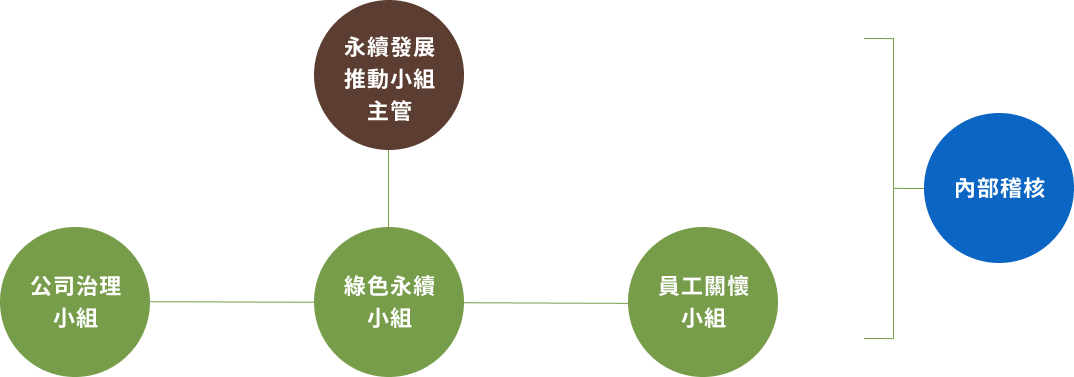
- Head of Sustainable Development Promotion Team
- ESG Overall Planning
- Each legal update
- Policy Drafting
- Corporate Governance Project and Related Stakeholder Communication Documents
- Company official website ESG section establishment
- Staff Care Group
- Employee safety and promotion of activities
- Staff Enhancement and Training
- Employee Care Activities
- Corporate Governance Group
- Understanding of Disclosure Standards in the Continuing Report
(GRI, TCFD, and SASB) - Draft of the First ESG Report
- Community feedback event promotion and data compilation
- Green Sustainability Group
- Greenhouse Gas Emission Statistics
- Statistics of water consumption and total weight of wastes
- Environmental Protection Data Tracking
- audit room
- Clarification of the legality of each regulation and compliance audit
- Confirmation of the Completeness of ESG Reporting




Corporate governance framework
Governance framework
- Governance Framework:
In accordance with the Code of Corporate Governance Practices for Listed OTC Companies, HAKERS has formulated the "Code of Business Integrity" and the "Code of Corporate Governance Practices" and published them on the Company's website to protect shareholders' rights and interests, strengthen the operation of the Board of Directors, establish good relationships with stakeholders, and enhance the transparency of information in order to fulfill its commitment to corporate governance. - Protection of shareholders' rights and interests:
The Board of Directors has formulated internal regulations such as the "Code of Business Integrity," "Code of Corporate Governance Practices," and "Procedures for the Handling of Material Internal Information and Prevention of Insider Trading," and conducts education and training from time to time to ensure that all employees of the Company understand and comply with the Code of Business Integrity and Ethics, which has further developed into a corporate culture that fully protects shareholders' rights and interests. - To strengthen the operation of the Board of Directors:
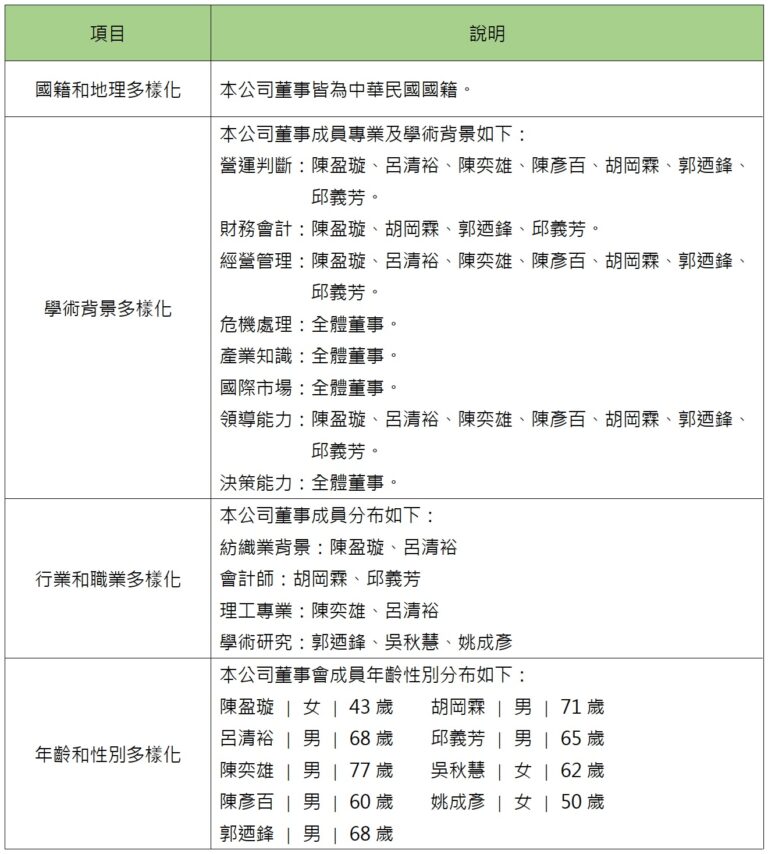
- Diversity: To promote board diversity, we aim for diversification in race and cultural background, nationality and geographic diversity, and professional and academic backgrounds to ensure directors possess the necessary knowledge, skills, and competencies to perform their duties. Currently, our company's board has 9 members with diverse backgrounds, including expertise in management, textiles, law, and accounting.
- Professional Development: The Company arranges at least 6 hours of continuing education for directors annually. By compiling diverse courses offered by various institutions, we provide rich course information, allowing directors to choose courses freely. Through up-to-date course content, directors maintain their core values, professional advantages, and capabilities. The continuing education hours for the Company's directors in 2025 were 6–9 hours.
- Effective operation: The Company has established the "Board of Directors Self-Evaluation or Peer Review Method" and the Board of Directors Performance Evaluation Method to enhance the effectiveness of the Board of Directors' operation.
- The Company has established a Corporate Governance Officer to assist the Board of Directors and its functional committees in the operation of their affairs and to improve the quality of the Board's decisions. The corporate governance structure consists of functional committees of the Board of Directors, the Audit Committee and the Compensation Committee, and the professional qualifications of the members of the functional committees are utilized to assist the Board of Directors in making the best possible decisions in order to enhance the performance of the Company's corporate governance.
- Establishment of good relationship with stakeholders: Minwang attaches great importance to the interaction with various stakeholders and endeavors to establish a good communication and cooperation platform in order to promote more effective communication and cooperation.
- Enhancement of Information Transparency: In addition to disclosing relevant financial information in accordance with laws and regulations, the Company has a corporate website in both English and Chinese on the Company's official website to enable investors or the general public to have a full understanding of the Company's information, has designated a dedicated staff to be responsible for the disclosure of information, and has a spokesperson system in place to ensure that information related to shareholders' rights and interests is disclosed in a timely and appropriate manner.
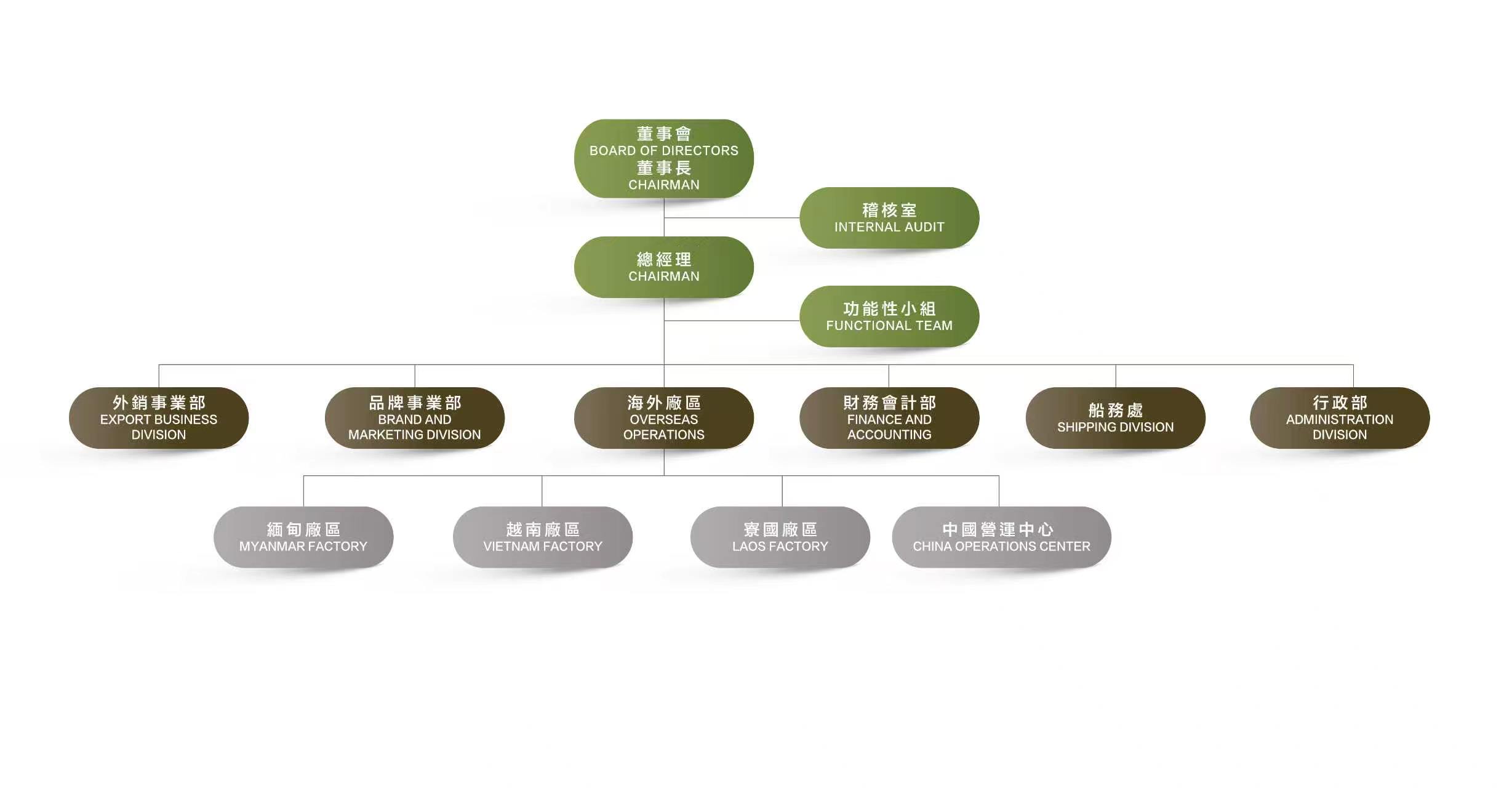
- Organizational Chart
Board of Directors
Members' Biographies and Powers and Responsibilities
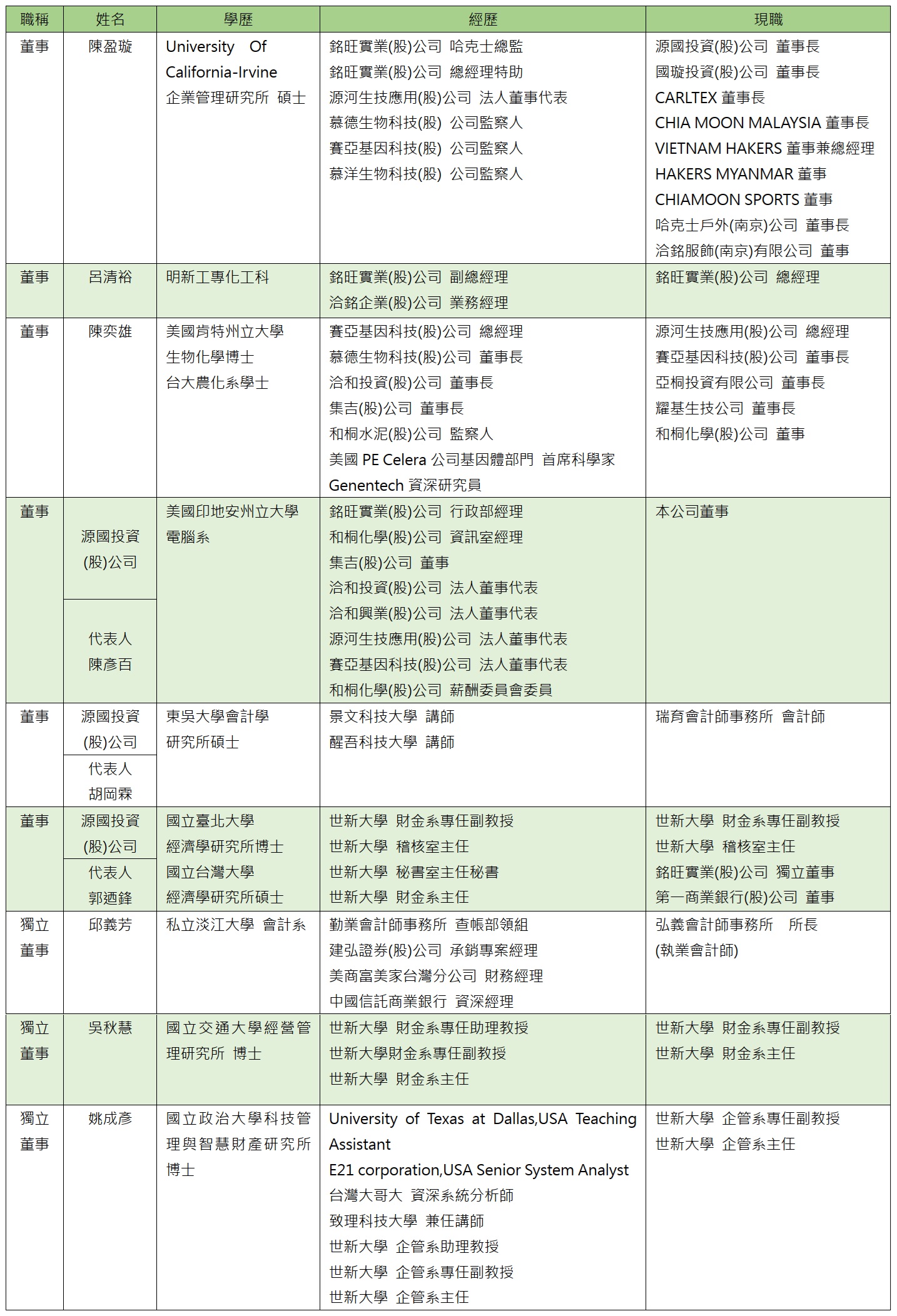
- The Company shall have five to ten directors, with a term of office of three years. Directors shall be elected by the shareholders' meeting from among persons with legal capacity. Directors may be re-elected. The number of directors shall be determined by a resolution of the board of directors. The election of directors of the Company shall adopt the nominee system as stipulated in Article 192-1 of the Company Act. Directors shall be elected by the shareholders' meeting from the list of nominees announced by the Company. Matters to be complied with shall be handled in accordance with relevant laws and regulations. The total shareholding ratio of all directors shall be handled in accordance with the regulations of the securities regulatory authority. Among the directors mentioned in the preceding paragraph, the number of independent directors shall not be less than three, and shall not be less than one-third of the total number of director seats. Independent directors shall be elected by the shareholders' meeting from the list of independent director nominees.
- Our company held its shareholders' meeting on May 29, 2026, and completely re-elected the 11th board of directors. Their term of office shall be from May 29, 2026, to May 28, 2029.
2026 | Board Resolutions
2025|Resolutions of the Board of Directors
2024|Resolutions of the Board of Directors
2023|Resolutions of the Board of Directors
2022|Resolutions of the Board of Directors
2021|Resolutions of the Board of Directors
2020|Resolutions of the Board of Directors
2019|Resolutions of the Board of Directors
2018|Resolutions of the Board of Directors
2017|Resolutions of the Board of Directors
2016|Resolutions of the Board of Directors
2015|Resolutions of the Board of Directors
2014|Resolutions of the Board of Directors
2013 - Board of Directors' Resolutions
2012|Resolutions of the Board of Directors
2011|Resolutions of the Board of Directors
11th Session | Board of Directors' Operations
The 10th Board of Directors
The 9th Board of Directors
The 8th Board of Directors
The 7th Board of Directors
Diversity policy and implementation
The purpose of the Board Membership Diversity Policy is to promote diversity in the organization at the Board level, including, but not limited to, diversity in terms of gender, race, culture, and professional background. The following is a copy of the Company's Board Membership Diversity Policy:
- is a policy of diversity for the members of the Company's Board of Directors:
- Diversity goals: The Company has set clear diversity goals, including gender balance, racial diversity, cultural background differences, and areas of specialization, which are described below by category:
- Ethnic and Cultural Diversity: Including members from different ethnic and cultural backgrounds on the Board helps to better understand and meet the needs of different markets and customers around the world, and to better address the challenges posed by cultural differences.
- National and geographic diversity: Having members from different countries and regions on the board of directors increases the company's global perspective and global market insights.
- Diversity of professional and academic backgrounds: Board members from different professional fields and academic backgrounds can provide diverse expertise and experience, facilitating more comprehensive discussions on strategy development and risk management.
- Industry and Occupational Diversity: Diverse industry and occupational backgrounds of board members can bring broader industry knowledge to help companies respond to industry changes and competitive challenges.
- Age and gender diversity: Having members of different ages on the board ensures that the company capitalizes on the wisdom and experience of different generations.
- RECRUITMENT AND NOMINATION PROCEDURES: Diversity recruitment and nomination procedures are in place to ensure that there is a sufficiently diverse pool of candidates on the slate of director candidates. The Company actively seeks out individuals with diverse backgrounds, as well as establishing diversity metrics in the list of candidates.
- Committee Diversity: Ensure that the Board Nominating Committee itself is diverse. This will help to promote a greater diversity of candidates to the slate of director nominees.
- Training and Development: Provide a diversity of training and development opportunities for current and potential board members. Such training should contribute to an understanding of diverse cultures and backgrounds, raise awareness and provide support to develop as an effective board member.
- Transparency Reporting: Disclosure of board diversity information in the company's annual report, including statistics on gender, ethnicity and cultural background Transparency reporting helps track progress and demonstrate the company's commitment to shareholders and stakeholders.
- Driving Culture Change: Foster a corporate culture that supports diversity and promotes inclusiveness and respect to attract and retain talent from diverse backgrounds.
- Establish a Diversity Committee: If the board needs a more in-depth diversity effort, consider establishing a dedicated Diversity Committee that will be responsible for developing strategies and driving the diversity process
- Diversity assessment: A diversity assessment mechanism is established to regularly assess the diversity of the Board of Directors to ensure the effective implementation of the diversity policy.
A description of the Company's current board diversity:
2024|Succession Planning and Operation of Board Members
Minwang Industrial Co., Ltd. - 114 Years of Succession
Functional Committee
Members' Biographies and Powers and Responsibilities
Members' Biographies and Powers and Responsibilities
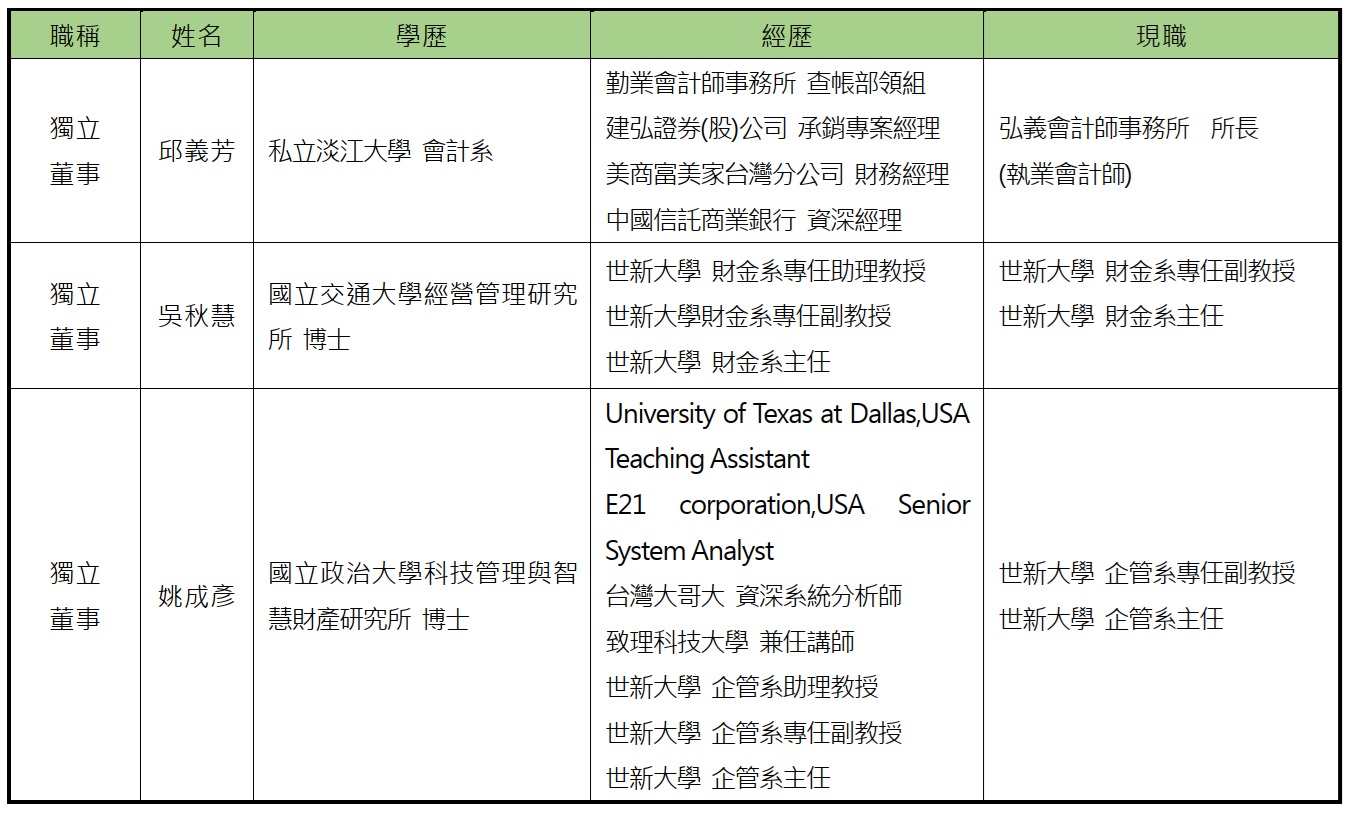
The independent director candidates elected by shareholders at the 2026 Annual General Meeting of Shareholders are as follows: Chiu, Yi-Fang; Wu, Chiu-Hui; Yao, Cheng-Yen.
The Company has a quota of three independent directors, who are elected by the shareholders' meeting from the list of independent director candidates under the candidate nomination system described in Article 192 of the Company Act. The professional qualifications, shareholdings, restrictions on concurrent positions, nomination and election methods, and other requirements for the nomination of independent directors shall be in accordance with the relevant provisions of the Company Act and the Securities and Exchange Act.
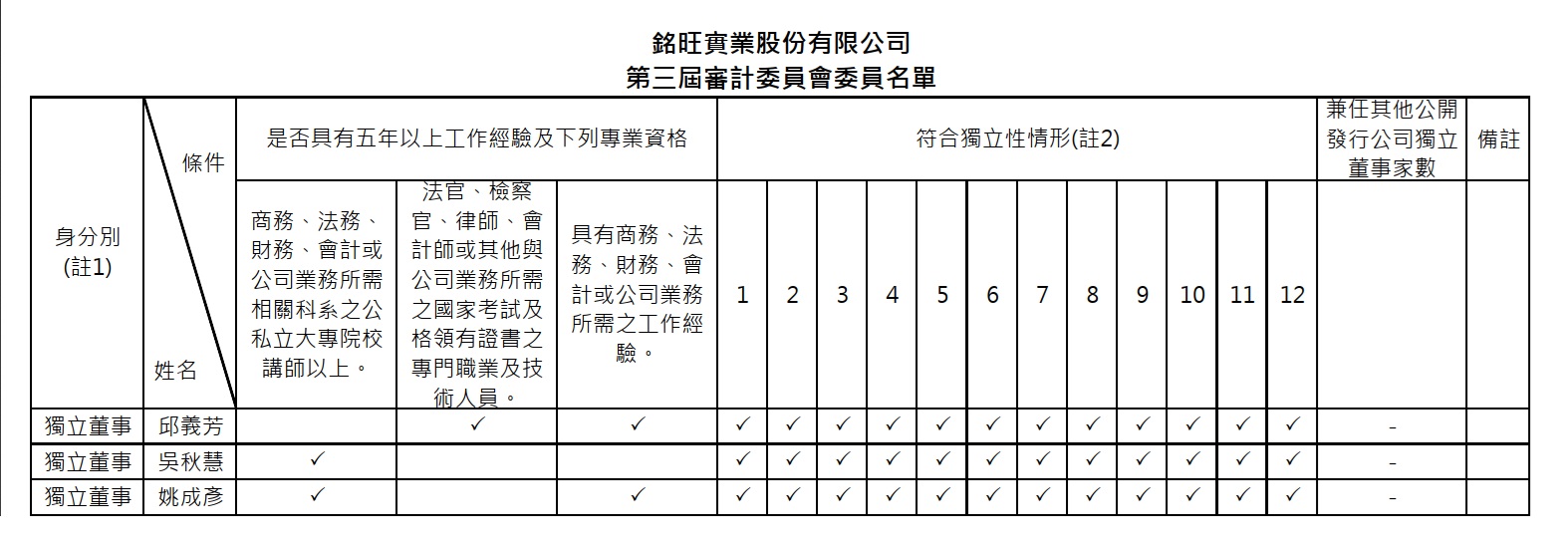
Note: If each director or supervisor meets the following conditions during the two years prior to his/her election and during his/her term of office, please place a ”v” in the box below each condition code.
- Not an employee of the Company or its affiliates.
- Directors and supervisors who are not corporations or their affiliates (except for those who are independent directors of the corporation and its parent company, subsidiaries, or subsidiaries belonging to the same parent company who serve as independent directors of the corporation and its parent company, subsidiaries, or subsidiaries belonging to the same parent company in accordance with this Law or local laws and regulations).
- A natural person shareholder who is not himself/herself, his/her spouse, minor children, or in the name of another person, and who holds more than 1% of the total number of issued shares of the Company, or who holds the top ten shares.
- Spouse, relative within the second degree of consanguinity, or relative within the third degree of consanguinity of a manager not listed in (1) or an officer not listed in (2) or (3).
- A director, supervisor, or employee of a corporate shareholder who does not directly hold 5% or more of the total number of the Company's outstanding shares, who is among the top five shareholders, or who has designated a representative to serve as a director or supervisor of the Company in accordance with Article 27, paragraph 1 or 2 of the Company Act (except in the case of an independent director of the Company and its parent, subsidiary, or subsidiaries that are part of the same parent company, who are concurrently serving as independent directors of the Company and its parent, subsidiary or subsidiaries that are part of the same parent company, as provided for under the Act or under the laws and regulations of the respective local country).
- A director, supervisor or employee of another company who is not controlled by the same person who holds more than one-half of the directorships or voting shares of the company (except in the case where independent directors of the company or its parent company, subsidiaries, or subsidiaries belonging to the same parent company serve concurrently with each other in accordance with this Law or the laws and regulations of the country where they are located).
- A director (board member), supervisor (supervisor), or employee of another company or organization who is not the same person or spouse of the Company's chairman, general manager, or equivalent (except in the case of independent directors of the Company and its parent company, subsidiary, or subsidiaries belonging to the same parent company, who are concurrently serving as directors of the Company and its parent company, subsidiary, or subsidiaries of the same parent company, as provided for in this Act or local laws and regulations).
- Directors (Governors), supervisors (Supervisors), managers, or shareholders holding 5% or more of shares who are not directors (Supervisors) of a specific company or organization that has financial or business dealings with the Company (provided that a specific company or organization that holds 20% or more of the Company's total number of issued shares and not more than 50%, and is a subsidiary of the Company and its parent, subsidiary, or subsidiary that is part of the same parent company in accordance with the Laws of this State or the laws of the country in which the Company operates) (Except for the case where the independent directors are concurrently serving each other).
- Business, legal, financial, accounting, and other related services professionals, sole proprietors, partners, directors, supervisors, managers, and their spouses who do not provide audits for the Company or its affiliates, or who have received an aggregate amount of compensation of less than NT$500,000 in the last two years. However, members of the compensation committee, public acquisition review committee, or special committee on mergers and acquisitions who are performing their duties in accordance with the Securities and Exchange Act or the Business Mergers and Acquisitions Act are not subject to this limitation.
- No spouse or consanguineous within two degrees of kinship with other directors.
- Failure to comply with any of the provisions of Section 30 of the Companies Act.
- Section 27 of the Companies Act does not provide for the election of the Government, a legal person or its representative.
Audit Committee Resolutions
Operation of the Audit Committee
Members' Biographies and Powers and Responsibilities
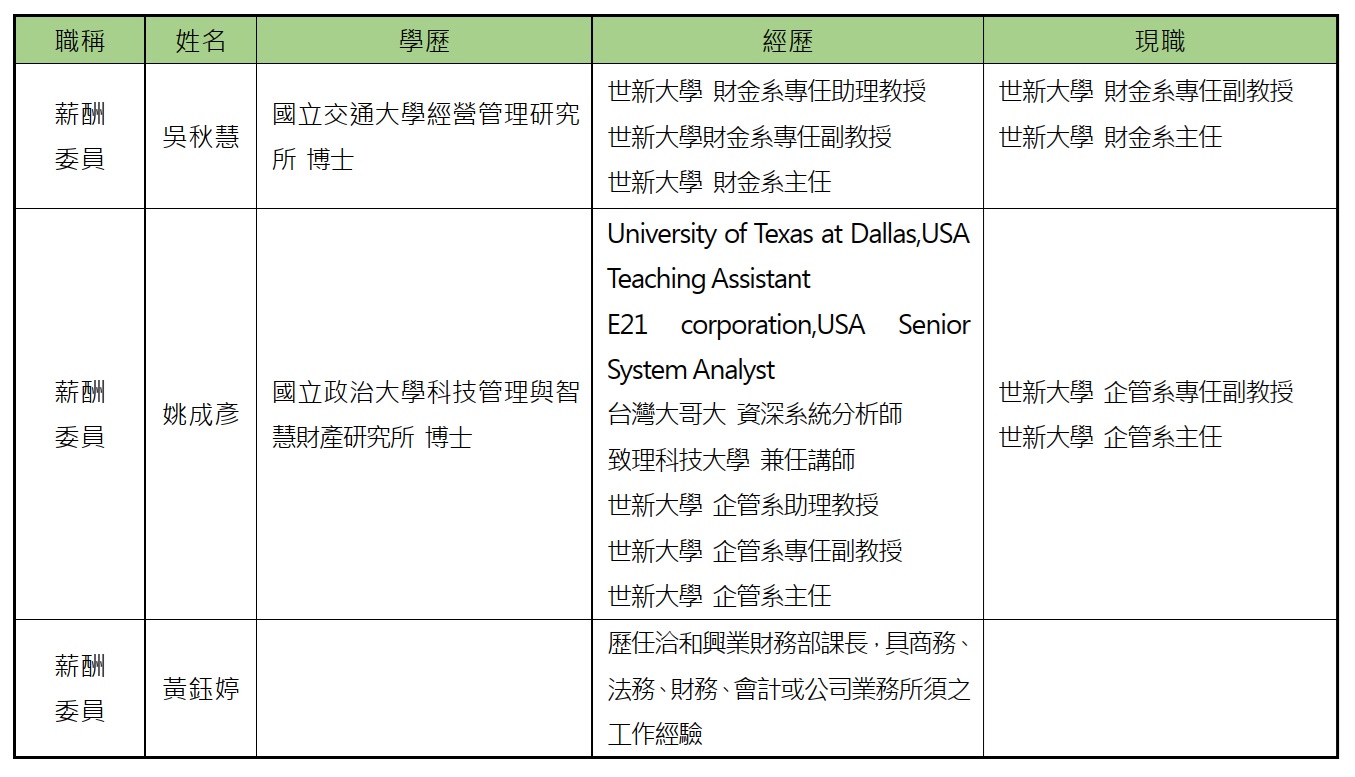
Resolutions of the Remuneration Committee
Operation of the Remuneration Committee
Internal Audit
Organization and Operation of Internal Audit
- goal
The purpose of the internal audit is to check and evaluate the deficiencies of the Company's internal control system and measure the effectiveness of its operations, to provide timely recommendations for improvement, to ensure the continuous and effective implementation of the internal control system, and to assist the Board of Directors and the managers in fulfilling their responsibilities. - Organizations
The Company's internal audit is an independent entity directly under the Board of Directors. The internal auditors uphold the spirit of independence and perform their duties in an objective and fair manner.
The audit office has an audit supervisor. The appointment and removal of the audit supervisor must be approved by a majority of the board of directors, and an appropriate number of full-time internal auditors will be assigned in accordance with the Company's size, business conditions, management needs, and other relevant laws and regulations.
The Audit Supervisor is responsible for planning, executing, coordinating, reporting, and tracking the progress of the audit operation, and attends the Board of Directors' meeting to report on the audit-related business. - Business Execution
The Audit Office prepares an annual audit plan based on the results of the risk assessment, including the items to be audited on a monthly basis. After approval by the Board of Directors, the Audit Office conducts audits and submits audit reports with work papers and related information, and provides timely recommendations for improvement to ensure the continuous and effective implementation of the internal control system, and conducts ad hoc audits as necessary.
Each unit and subsidiary of the Company is urged to periodically check the effectiveness of its internal control system on its own each year, and then the audit office reviews the self-inspection reports of each unit and subsidiary, examines the implementation of various operations and related documents, and improves the internal control deficiencies and anomalies identified by the audits, which serve as the main basis for the Board of Directors to evaluate the effectiveness of the overall internal control system and issue a statement of internal control.
Corporate Governance Disclosure
Top Ten Shareholders Shareholding Relations Table - Year 115
Board of Directors Performance Evaluation 114
114 Yearly Accountant's Independence Assessment
114 Years of Information Security Information Disclosure
1141222 Minutes of Corporate Governance Meetings (Independent Directors and Accountants)
114 Years of Operation and Implementation of Honest Management Policy, Intellectual Property Management, Prevention of Dishonest Behavior, and Protection of Trade Secrets
Enhancing Corporate Value Program
Table of Interrelationships among Top Ten Shareholders - 114 Years
113 Board of Directors Performance Evaluation
1140307 Corporate Governance Minutes (Independent Directors and Accountants)
1131218 Corporate Governance Minutes (Independent Directors and Accountants)
113 Accountant's Independence Assessment
113 Years of Information Security Information Disclosure
112 Board of Directors Performance Evaluation
1130315 Corporate Governance Minutes (Independent Directors and Accountants)
112 Years of Information Security Information Disclosure
112 Terms of Reference of the Head of Governance and Further Study
1121227 Corporate Governance Minutes (Independent Directors and Accountants)
The operation and execution of the part-time unit of corporate integrity management in 2012
Accountant's Independence Evaluation for 112 years in the R.O.C.
1121214 Corporate Integrity Presentation
Table of Interrelationships among Top Ten Shareholders - 112 Years
1120324 Corporate Governance Minutes (Independent Directors and Accountants)
111 Board of Directors Performance Evaluation Report
1111230 Corporate Governance Minutes (Independent Directors and Accountants)
111 Accountant's Independence Assessment